


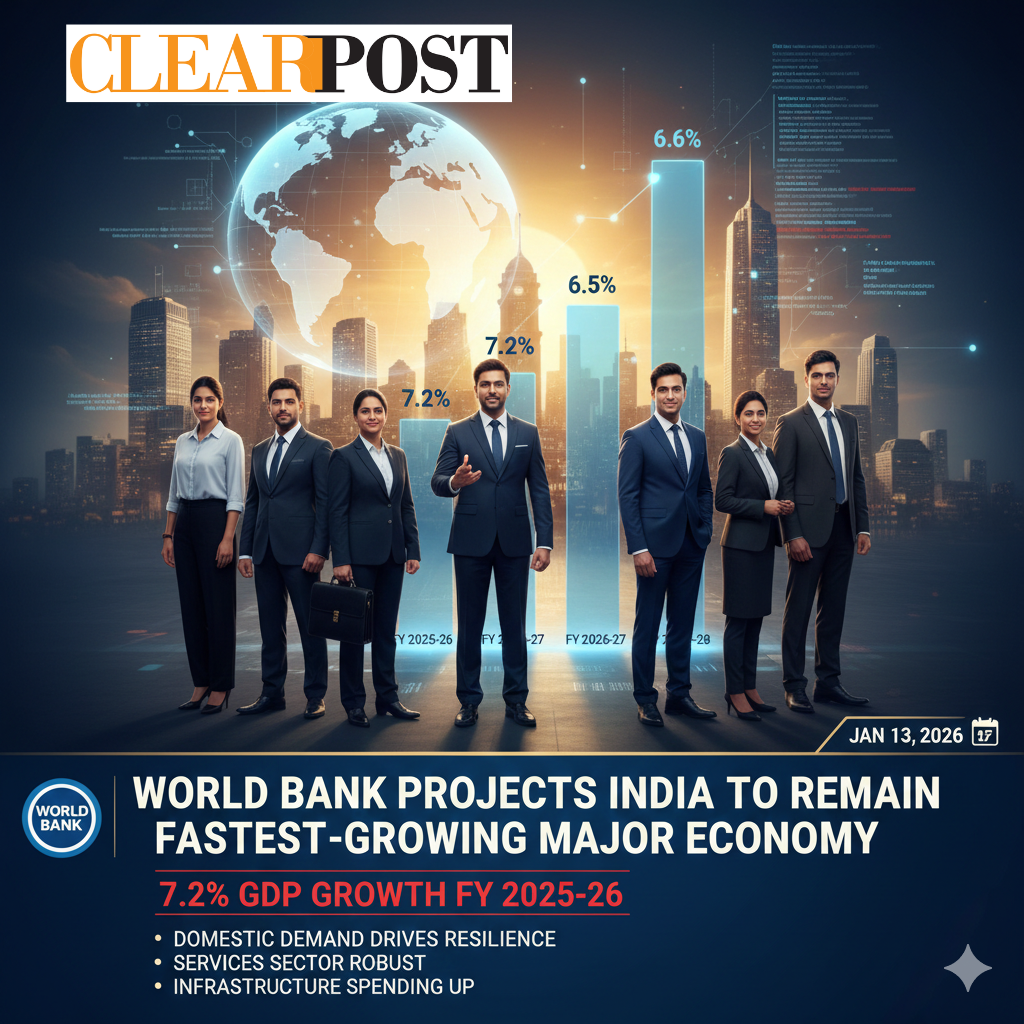
The World Bank released its semi-annual Global Economic Prospects report on Tuesday, January 13, 2026, confirming that India is projected to remain the fastest-growing major economy globally through 2027.
Despite significant global headwinds, including a projected 50% US import tariff on certain goods, India’s economic resilience is being driven by powerful domestic demand and a robust services sector.1
Key Growth Projections
The World Bank has provided the following GDP growth estimates for India’s upcoming fiscal years:
| Fiscal Year | GDP Growth Projection | Status / Trend |
| FY 2025–26 | 7.2% | Upgraded from 6.3% (June 2025 estimate) |
| FY 2026–27 | 6.5% | Retained/Stable; assumes US tariffs remain |
| FY 2027–28 | 6.6% | Slight pickup due to investment recovery |
Context: While the 6.5% figure for FY27 represents a moderation from the current year, it is still significantly higher than the projected global average of 2.6% and emerging market average of 4%.2
Primary Growth Drivers
1. Robust Domestic Consumption3
The report highlights that private consumption remains the backbone of the economy.4 This has been bolstered by:
-
Tax Reforms: Recent cuts in personal income tax and GST (Goods and Services Tax) have increased disposable income.5
-
Rural Recovery: Improvements in real household earnings in rural areas have stabilized demand for consumer goods.6
2. Services Sector Resilience
India’s services exports—particularly in IT and business consulting—continue to perform strongly.7 These surpluses are helping to offset deficits in merchandise trade caused by shifting global trade policies.8
3. Public Capital Expenditure
Continued government spending on infrastructure and digitalization is expected to keep investment activity steady, even as private-sector credit growth remains “restrained” due to macroprudential policies aimed at containing banking risks.9
Risks and Challenges
-
Trade Tensions: The World Bank’s baseline assumes that the 50% US import tariffs will stay in place.10 While this impacts roughly 12% of India’s merchandise exports, the bank believes strong domestic momentum will largely “offset” the damage.11
-
Fiscal Consolidation: The Indian government is moving toward a new framework targeting a debt-to-GDP ratio of 50% by March 2031.12 This focus on reducing debt may limit some immediate public spending but is seen as a long-term stabilizer.13
-
Global Slowdown: The current decade is on track to be the weakest for global growth since the 1960s, which could eventually weigh on India’s external demand.14
Expert Commentary
Indermit Gill, World Bank Group’s Chief Economist, noted:
“With each passing year, the global economy has become less capable of generating growth and seemingly more resilient to policy uncertainty.15 India remains a bright spot, but to avoid stagnation, governments must continue to aggressively liberalize private investment.”16
Would you like me to compare these World Bank figures with the latest projections from the IMF or the United Nations?