


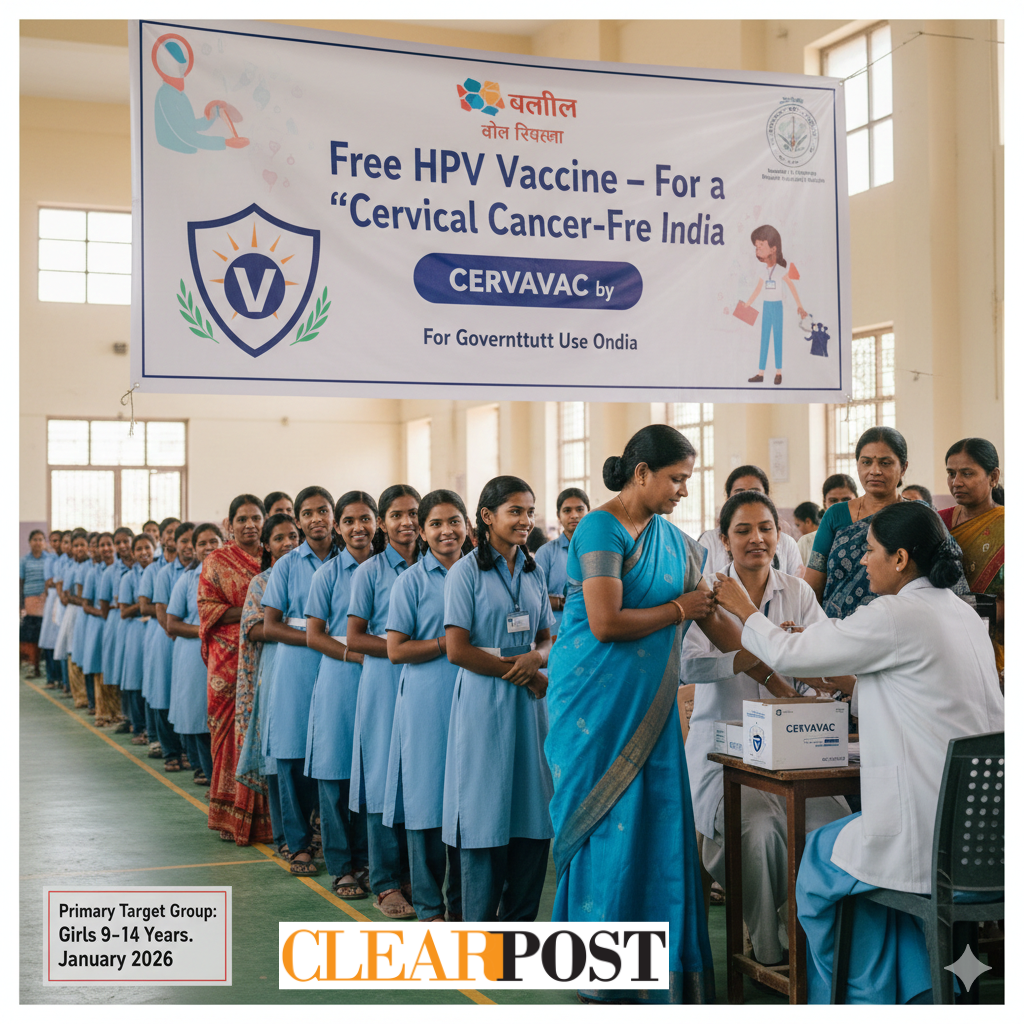
In January 2026, India’s battle against cervical cancer reached a decisive stage with the massive expansion of the Human Papillomavirus (HPV) vaccine program. Following the roadmap set in the 2024 Budget, the government has transitioned from pilot projects to a large-scale rollout under the Universal Immunization Programme (UIP).
Cervical cancer remains the second most common cancer among Indian women, and this expansion aims to protect the next generation before they are exposed to the virus.1
The 2026 National Rollout: Key Facts
The Ministry of Health has officially integrated the HPV vaccine into the routine immunization schedule for girls nationwide.
- Primary Target Group: Girls aged 9 to 14 years.2
- The Venue: Vaccinations are being conducted primarily through government and aided schools, with catch-up sessions held at local Ayushman Arogya Mandirs (Primary Health Centres).3
- The Vaccine: The campaign relies heavily on CERVAVAC, India’s first indigenously developed quadrivalent HPV vaccine produced by the Serum Institute of India (SII).4
- Cost: The vaccine is provided free of charge at all government facilities.5
State-Level Expansion Updates
Several states have taken the lead in the first two weeks of January 2026:
| State | Status as of January 2026 |
| Maharashtra | Scaling up statewide after receiving 9.5 lakh doses; free shots available at all public health facilities for girls 9–14. |
| Tamil Nadu | Launching a pilot in four high-burden districts (Tiruvannamalai, Ariyalur, Perambalur, and Dharmapuri) starting the third week of January. |
| Karnataka | Implementing targeted drives in mining-affected districts, covering over 37,000 beneficiaries. |
| Telangana | Completed technical training for health officers in Hyderabad; field-level rollout initiated this month. |
Production & Pricing Breakthroughs
The success of the 2026 expansion is largely due to the “Make in India” initiative:
- Manufacturing Surge: The Serum Institute of India (SII) has met its goal to double production capacity to 140 million doses annually by 2026.
- Affordability: While the vaccine costs up to ₹4,000 in the private market, the government procures it for approximately ₹300–₹400 per dose, making a national free program fiscally viable.
- The Single-Dose Shift: Based on 2025 clinical trials and WHO recommendations, India is increasingly adopting a single-dose regimen for the 9–14 age group, which simplifies logistics and reduces costs by half compared to the traditional two-dose schedule.
Addressing “The Missing Middle”
While the government focus is on school-aged girls, the Indian Medical Association (IMA) has launched a parallel initiative for women aged 15 to 45:
- Discounted Access: Starting after March 2026, the IMA will offer the HPV vaccine to the general public for ₹1,000 (roughly half the market rate).6
- Training: 50,000 physicians have been trained to administer the vaccine and counsel patients on the importance of screening alongside vaccination.7
“Our goal is clear: to ensure that by 2030, no girl in India enters adulthood without the protection of the HPV vaccine.” — National Health Mission Spokesperson
Would you like me to generate an image of a school-based vaccination camp in India featuring the CERVAVAC vaccine, or should I help you find the nearest government center for a check-up?