


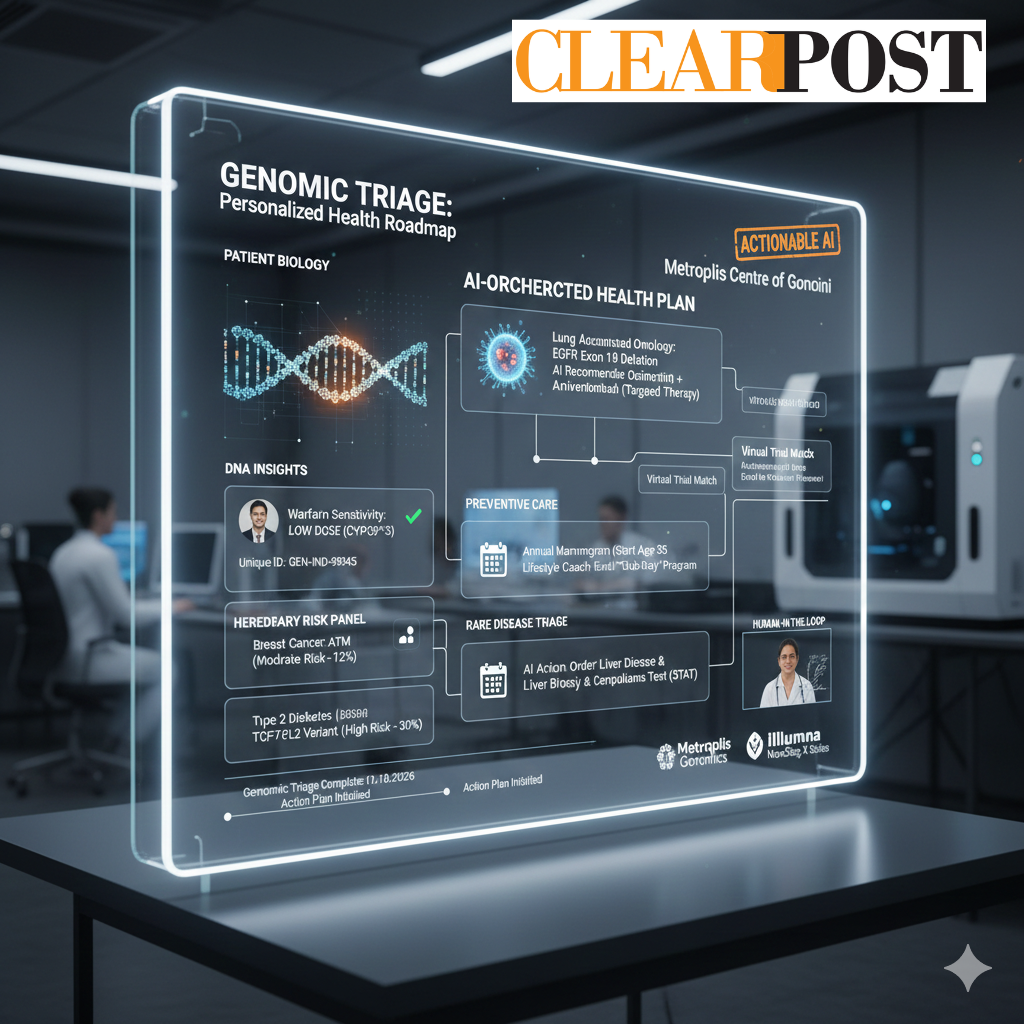
In January 2026, the global healthcare narrative has shifted from the “promise” of technology to the era of Actionable AI and Genomics.1 This transition marks a move from simple data collection to “agentic” systems that don’t just predict risks but autonomously orchestrate personalized treatment plans.2+1
India, specifically, is emerging as a global hub for this convergence, leveraging its unique genetic diversity and new indigenous infrastructure.3
Actionable AI: From Prediction to Orchestration
By early 2026, AI in healthcare has moved beyond “chatbots” to Actionable AI—systems integrated directly into clinical workflows that suggest specific medical roadmaps.4
- Agentic Workflows: Unlike previous models that only flagged anomalies, 2026 agents can autonomously coordinate care, such as scheduling follow-up tests, verifying insurance, and drafting discharge summaries for human sign-off.
- RAG-Powered Reliability: To eliminate “hallucinations,” hospitals are now using Retrieval-Augmented Generation (RAG), which grounds AI responses in real-time medical literature and specific hospital protocols.
- Diagnostic Precision: AI platforms like Metropolis’s new Centre of Genomics (launched Jan 13, 2026) are using AI-driven trend correlations to translate complex raw data into clinically actionable insights for oncology and rare diseases.5
The Genomics Revolution in India
Genomics has officially moved from a “niche luxury” to a “primary triage tool” in the Indian diagnostic sector.6
- The Genome India Project Legacy: Building on the completion of the 10,000-genome project in 2025, 2026 sees the rollout of Population-Scale Screening.7 This allows for “region-specific” medicine tailored to the genetic predispositions of India’s 99+ ethnic groups.8+1
- Genomic Triage: Routine blood work is now increasingly paired with genetic markers.9 This allows clinicians to predict and prevent chronic conditions like diabetes or hypertension decades before physical symptoms appear.10
- Affordability & Scale: With the deployment of ultra-high-throughput systems like the Illumina NovaSeq X Series in Indian labs, the cost of whole-genome sequencing has reached an “inflection point,” making it accessible to the middle class.
Key Applications & Impact in 2026
| Field | How Actionable AI + Genomics Works | 2026 Real-World Impact |
| Oncology | AI analyzes tumor mutations to recommend specific targeted therapies or ADCs (Antibody-drug conjugates). | 30% increase in first-line treatment success. |
| Rare Diseases | Long-read sequencing identifies complex cases missed by standard tests; AI matches patients to global trials. | Diagnostic odyssey reduced from years to weeks. |
| Pharmacogenomics | AI predicts how a patient will metabolize a drug based on their DNA before a prescription is written. | Significant reduction in adverse drug reactions (ADRs). |
| Newborn Screening | Rapid NGS screens for 110+ treatable disorders not covered by traditional heel-prick tests. | Early intervention for conditions like Wilson disease. |
The “Smart Pipeline” in Drug Discovery
The pharmaceutical industry has entered the “Smart Pipeline” era.11 AI agents now autonomously propose biological targets and run “virtual experiments” using Digital Twins—virtual models of a patient’s biological system.12+1
- Virtual Trials: In 2026, regulators are increasingly accepting AI-generated evidence and Synthetic Control Arms (replacing placebos) to accelerate drug approvals.13
- India’s BioE3 Vision: The Indian government’s focus on Biotechnology for Economy, Employment and Environment is fueling local manufacturing of genomic kits, reducing import dependency.
“2026 is the year we stop treating everyone for the same disease and start treating each individual for their specific biology.” — Deepak Sahni, Healthians Founder14