


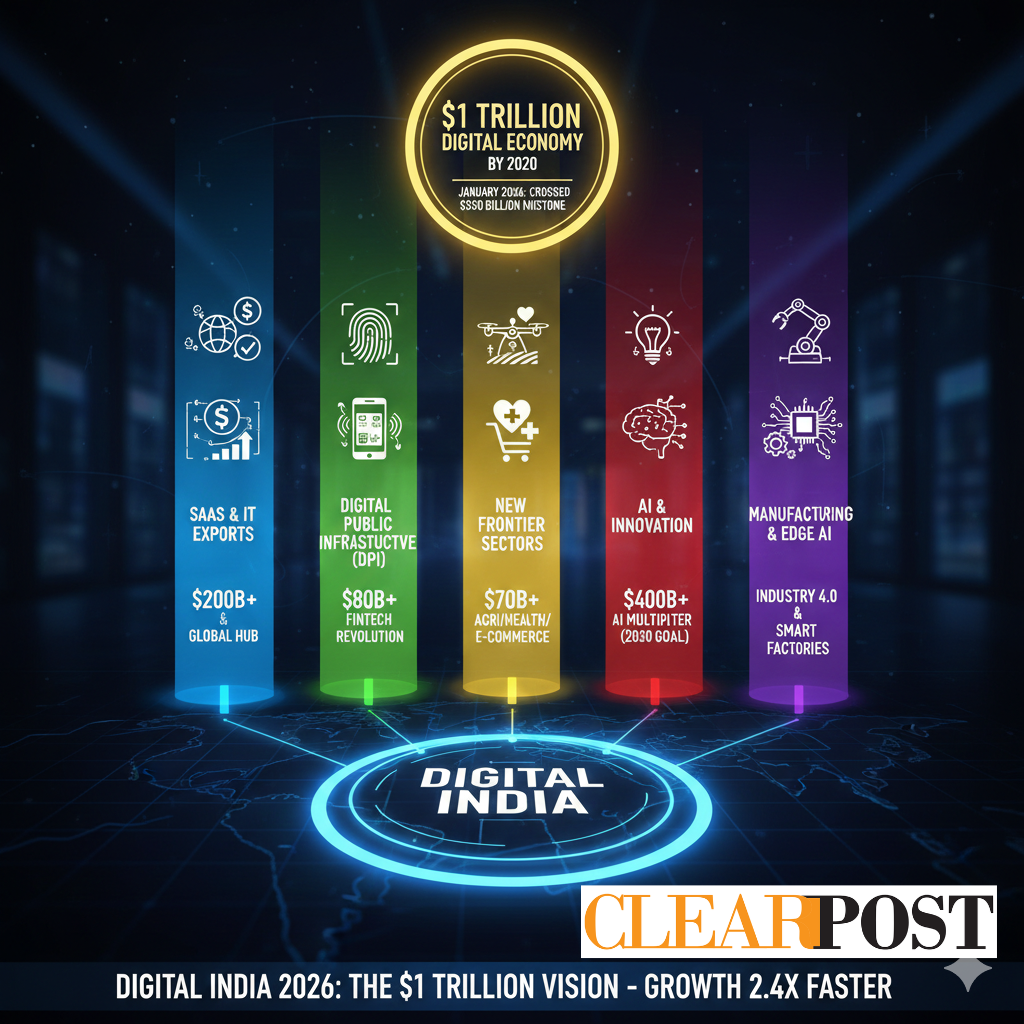
In mid-January 2026, the Indian economy has crossed a historic threshold as the Digital Economy hits the $350 billion valuation mark. This milestone confirms that India’s technology and digital services sector is now growing nearly 2.4 times faster than the overall economy, firmly placing it on the path to becoming a $1 trillion digital powerhouse by 2030.
According to reports from the Ministry of Electronics and IT (MeitY) and recent advanced GDP estimates, the digital sector now contributes approximately 10% of India’s total GDP.
The Anatomy of the $350 Billion Milestone
The surge to $350 billion in early 2026 is driven by a “Triple Engine” of growth:
1. The SaaS & IT Export Engine ($200B+)
Despite global headwinds, India’s software exports remain the backbone of the digital economy.
- Global Hub: India now hosts over 55% of the world’s Global Capability Centers (GCCs). These aren’t just back-offices anymore; they are the R&D hubs for AI, cloud, and cybersecurity for Fortune 500 companies.
- The “Silicon Shield”: Strategic partnerships signed in late 2025 (including the India-Japan Economic Security Pact) have secured massive investment in domestic semiconductor design, adding high-value IP to the export mix.
2. The DPI & Fintech Revolution ($80B+)
Digital Public Infrastructure (DPI) has moved from “innovation” to “infrastructure.”
- The UPI Maturity: In 2025-26, UPI isn’t just for chai stalls; it’s the global gold standard. With monthly transactions now consistently crossing 1,500 crore, the focus has shifted to cross-border linkages with the UAE, Singapore, and Europe.
- Direct Benefit Transfer (DBT): The government has saved over ₹3.5 lakh crore in leakages since the program’s inception, capital that is now being reinvested into rural digital connectivity.
3. The “New Frontier” Sectors ($70B+)
For the first time in 2026, sectors like Agri-tech, Health-tech, and Ed-tech are contributing significant billions to the digital total.
- E-Commerce Boom: India now has the world’s second-largest universe of online shoppers, with Tier-2 and Tier-3 cities contributing 80% of new users.
- The AI Multiplier: Generative AI is projected to add nearly $400 billion to the GDP by 2030, but its initial impact is already being felt in 2026 through hyper-automated customer service and coding efficiencies.
The 2026 “Digital Economy” Scorecard
| Metric | 2021-22 Status | January 2026 Status |
| Digital GDP Share | ~4.5% | ~10% |
| Smartphone Users | ~75 Crore | ~95 Crore |
| Startup Ecosystem | ~60,000 Startups | ~1,40,000+ Startups |
| Unicorn Count | ~100 | 125+ |
| IT Workforce | ~5 Million | ~7.5 Million |
Key Challenges Remaining
While the $350 billion mark is a triumph, 2026 policymakers are focused on the “Second Half” of the digital divide:
- The Gender Gap: Only 20% of Indian women are currently considered “digitally literate” enough to engage in the formal digital economy.
- Cyber Resilience: As the economy digitizes, fraud has scaled alongside it. The government is expected to announce a massive National Cyber Security Corpus in the upcoming Budget 2026-27 to protect this $350 billion asset.
“We are no longer just a ‘back-office’ for the world. In 2026, India is the world’s largest real-world laboratory for digital-first governance and commerce.” — Excerpts from the IBEF Growth Report, Jan 2026