


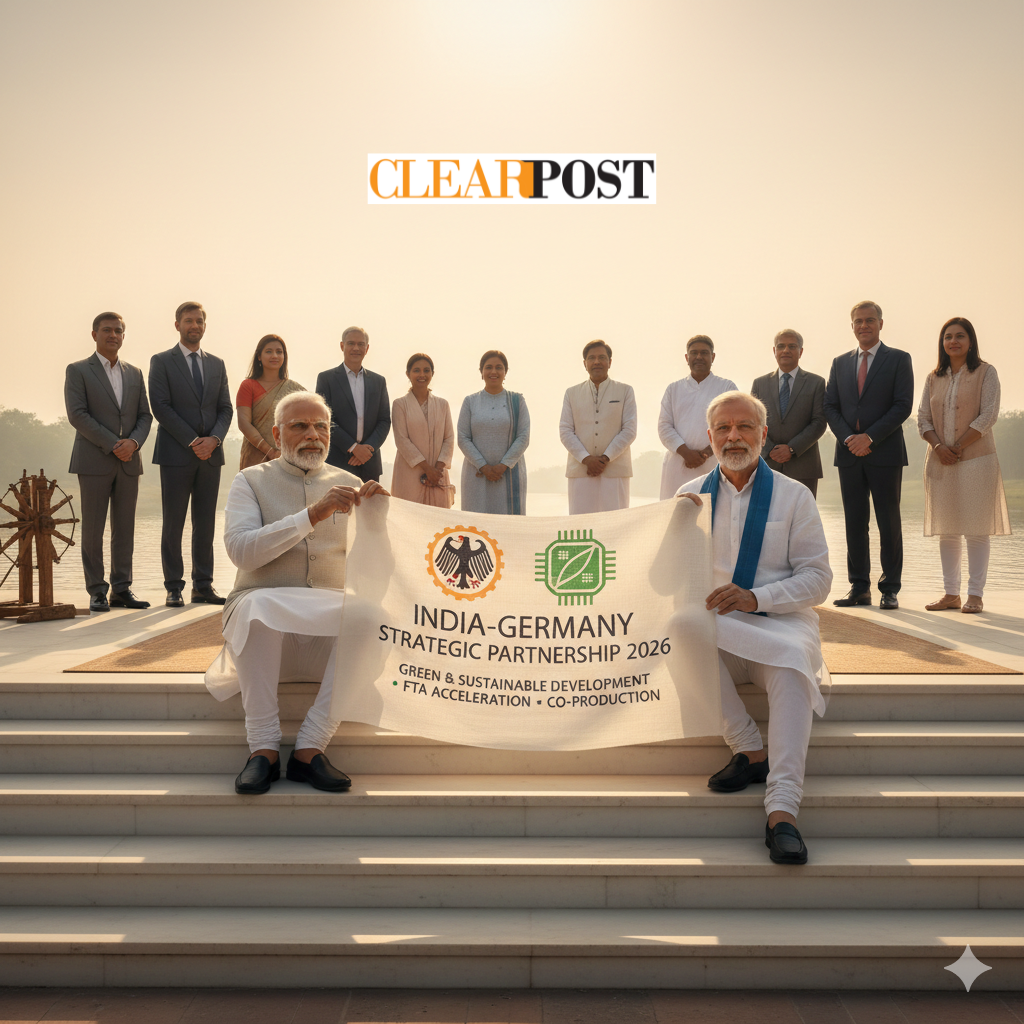
Earlier this week, from January 12–13, 2026, German Chancellor Friedrich Merz concluded his maiden visit to India, signaling a “strategic turning point” in bilateral relations.1 Accompanied by 23 top German CEOs, the visit spanned Ahmedabad and Bengaluru, moving the partnership from traditional trade toward deep industrial and defense co-production.2+1
1. The Green & Sustainable Development Partnership (GSDP)3
The visit marked the “half-time” review of the GSDP, a flagship initiative where Germany has pledged €10 billion to India by 2030.4
- New Funding: Germany announced an additional €1.24 billion in commitments for renewable energy, green hydrogen, and climate-resilient urban infrastructure.5
- Green Ammonia Deal: A landmark offtake agreement was signed between India’s AM Green and Germany’s Uniper for the supply of 250,000 tonnes of green ammonia per year, scaling up to 500,000 tonnes.6
- Knowledge Hubs: Both nations launched the Indo-German Centre of Excellence for Skilling in Renewable Energy in Hyderabad.7
2. The India-EU FTA: “The Home Stretch”8
Chancellor Merz and PM Modi placed heavy political weight on finalizing the India-EU Free Trade Agreement (FTA) in 2026.9
- Political Resolve: Following Minister Piyush Goyal’s recent trip to Brussels, both leaders described the FTA as a “game-changer” that would reduce dependencies on China and shield both economies from global protectionist trends.10
- Key Friction Points: While talks are in the final stages, negotiators are still fine-tuning details on the EU’s Carbon Border Adjustment Mechanism (CBAM) and technical standards for machinery.
3. Defence and Technology Breakthroughs
The visit saw the signing of 27 outcome documents, with defense emerging as a primary pillar:11
- Defence Roadmap: A Joint Declaration of Intent was signed to create a Defence Industrial Cooperation Roadmap, focusing on the co-development of military hardware and technology transfer.12
- Semiconductors & Minerals: India and Germany formalised a Semiconductor Ecosystem Partnership, aimed at integrating Indian talent into German high-tech value chains.13
- Critical Minerals: A new pact will see the two nations collaborate on the exploration and recycling of minerals essential for the EV and battery industries.14
4. Mobility & People-to-People Ties
In a significant win for Indian travelers and professionals:
- Visa-Free Transit: Germany announced visa-free transit for Indian passport holders through German airports.15
- Skilled Migration: A new “Global Skills Partnership” was launched, specifically focusing on the ethical recruitment of Indian healthcare professionals to Germany.16
Key Takeaway for 2026
+1
Chancellor Merz’s visit confirms Germany’s shift toward India as its primary strategic anchor in Asia.17 By moving beyond simple buyer-seller dynamics into co-production (especially in defense and green energy), the two nations are creating a “resilience shield” against the economic volatility seen elsewhere in 2026.18+1