


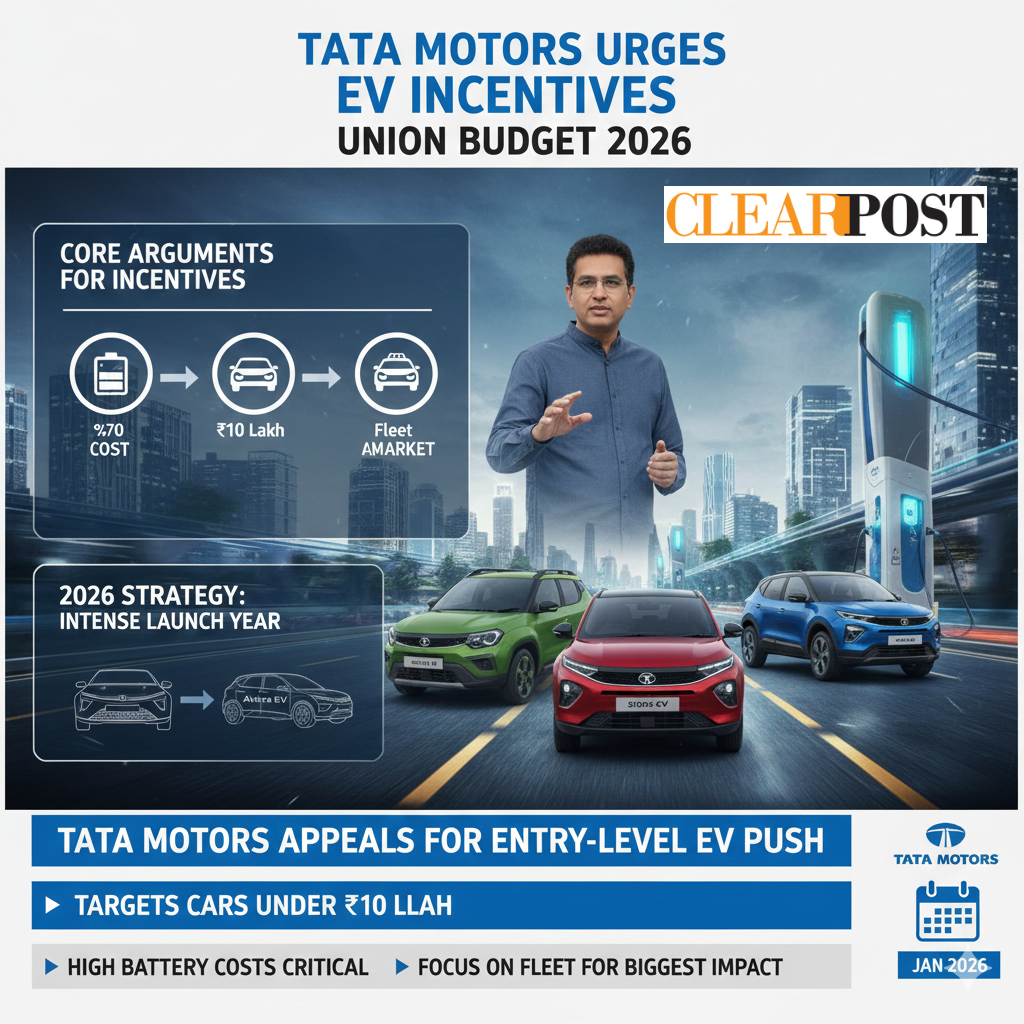
As the Union Budget 2026 approaches, Tata Motors has made a strong appeal to the Central Government to reintroduce targeted incentives for entry-level electric vehicles (EVs).1 Shailesh Chandra, MD and CEO of Tata Passenger Vehicles, emphasized that support for cars priced below ₹10 lakh is essential for EVs to transition from a niche market to the mainstream.2
This demand comes at a critical time when the industry is shifting from the older FAME II regime to the new PM E-Drive scheme, which has significantly reduced per-unit subsidies for personal cars.
The Core Arguments for Incentives
Tata Motors highlighted three primary structural challenges that make government support vital for the entry-level segment:3
-
High Battery Costs: For small cars like the Tiago.ev and Tigor.ev, the battery can account for nearly 70% of the total vehicle cost.4 Customers in this segment still expect a range of over 400 km, making it difficult to achieve price parity with petrol cars without aid.5
-
Mass Market Reach: More than 50% of Indian car buyers look for vehicles priced under ₹10 lakh.6 Tata Motors argues that if EVs do not “click” in this specific price bracket, mass adoption will remain a distant goal.7
-
Impact of GST Changes: Recent adjustments in GST and tax rationalizations have narrowed the price gap between Internal Combustion Engine (ICE) vehicles and EVs, but entry-level buyers remain highly price-sensitive.
Focusing on the “Fleet” Advantage
A major part of the appeal is for the reintroduction of incentives for the fleet segment (taxis and commercial aggregators).8
-
High Mileage: While fleet vehicles represent only 7–8% of total sales, they account for roughly 35% of total passenger kilometers driven in India.9
-
Environmental ROI: Tata Motors argues that subsidizing a taxi provides a much higher “environmental return on investment” than subsidizing a private car, as taxis are on the road much longer and displace more carbon emissions.
2026 Strategy: An “Intense” Launch Year
Despite the call for subsidies, Tata Motors is doubling down on its “Viksit Bharat” goals with an aggressive product cycle for 2026:10
-
The “Sierra” Return: One of the most anticipated launches of 2026 is the Sierra EV, aimed at the premium SUV segment.
-
Avinya Brand: The company plans to launch its luxury EV brand, Avinya, by the end of 2026.11
-
Punch Facelift: A refreshed Punch micro-SUV (including its EV variant) was launched just this week to maintain Tata’s dominance as the #2 player in the Indian market.12
Summary of Tata Motors’ EV Lineup (Jan 2026)
| Model | Starting Price | Primary Target |
| Tiago.ev | ~₹7.99 Lakh | Entry-level / City Commute |
| Punch.ev | ~₹9.99 Lakh | Micro-SUV / Versatile |
| Nexon.ev | ~₹12.49 Lakh | Mid-size SUV / Tech-focused |
| Harrier.ev | ~₹21.49 Lakh | Premium SUV / Long-range |
Would you like me to generate an image reflecting Tata Motors’ 2026 EV vision, or should I track the market’s response to the new Punch facelift?