


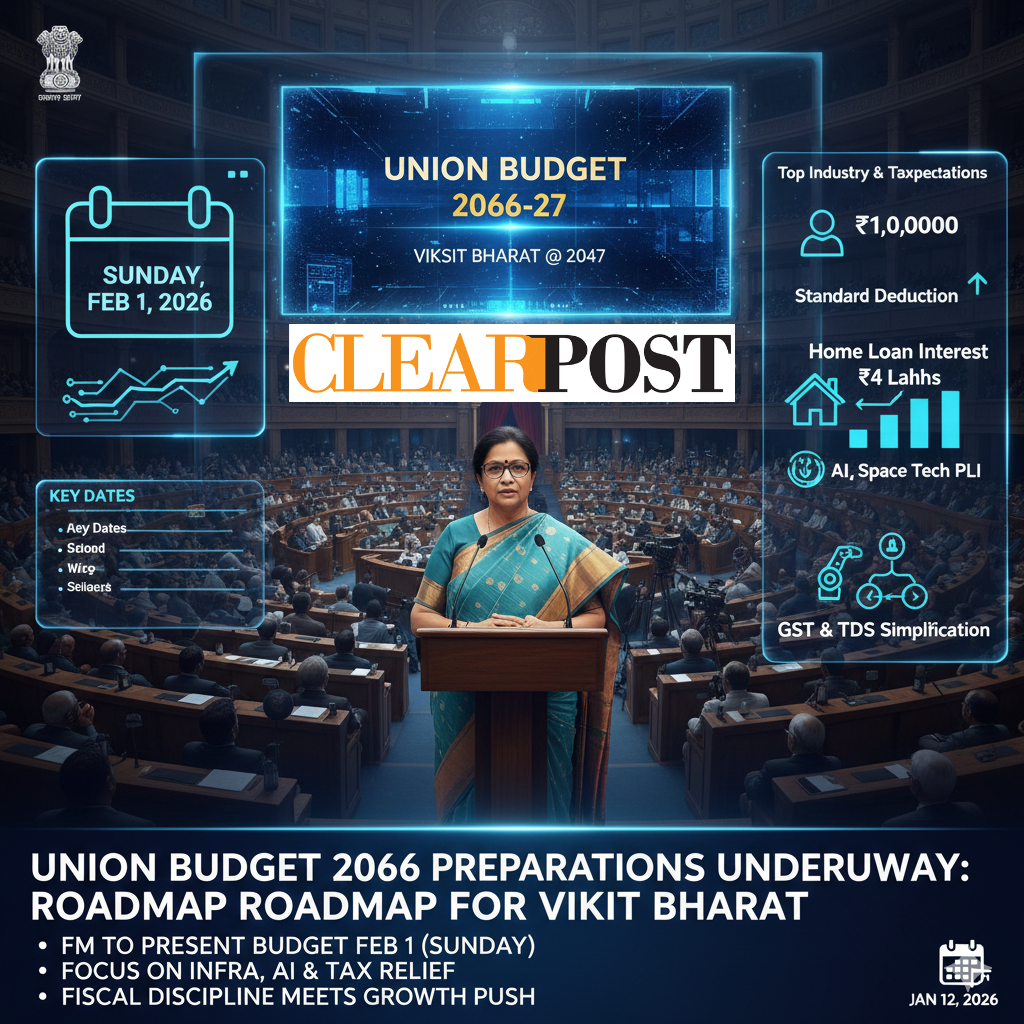
Preparations for the Union Budget 2026-27 are in full swing as Finance Minister Nirmala Sitharaman gears up to present her ninth consecutive budget.1 In a rare move, the Budget will be presented on Sunday, February 1, 2026, as confirmed by Lok Sabha Speaker Om Birla on January 12.2
The upcoming budget is seen as a critical roadmap for the “Viksit Bharat” (Developed India) 2047 vision, focusing on maintaining fiscal discipline while boosting consumption.3
Key Dates & Schedule
| Event | Date |
| Budget Session Begins | January 28, 2026 |
| Economic Survey Tabled | January 30, 2026 |
| Union Budget Presentation | February 1, 2026 (Sunday, 11 AM) |
| First Phase Ends | February 13, 2026 |
| Second Phase Starts | March 9, 2026 |
| Session Concludes | April 2, 2026 |
Major Preparatory Milestones
-
Pre-Budget Consultations: The Finance Minister chaired high-level meetings with State Finance Ministers on January 10, 2026, in New Delhi.4 States like Kerala have already submitted “wish lists” focusing on special fiscal packages and infrastructure corridors.
-
Nominal GDP Targets: Reports suggest the government may pencil in a 10% nominal growth rate for FY27, up from the current 8%, providing more fiscal room for strategic spending.5
-
Viksit Bharat Focus: PM Modi is scheduled to meet with top economists and sector experts this week to fine-tune the budget’s emphasis on AI, green energy, and the “blue economy.”6
Top Industry & Taxpayer Expectations
1. Relief for the Salaried Class
-
Standard Deduction: There is a strong push to increase the standard deduction from ₹75,000 to ₹1,00,000 to combat urban inflation.7
-
Home Loans: Stakeholders are urging the government to double the interest deduction limit under Section 24(b) from ₹2 lakh to ₹4 lakh.
2. Implementation of the New Income Tax Act
Budget 2026 is expected to outline the rollout of the Income-tax Act, 2025, which aims to simplify the tax code and reduce litigation.8 It is expected to take effect from April 1, 2026.
3. Boosting New-Age Technology
Experts predict the extension of the Production-Linked Incentive (PLI) schemes to futuristic sectors like Artificial Intelligence (AI), Space Tech, and Robotics to catalyze private investment.9
4. Simplification of GST & TDS
Industry bodies have requested a roadmap to rationalize the complex TDS structure (currently 37 different types of payments) down to just 3–4 standardized rates to improve business cash flows.10
Would you like me to generate a summary image of these budget expectations, or should I deep-dive into the specific “wish list” of a particular sector like Healthcare or EV?