


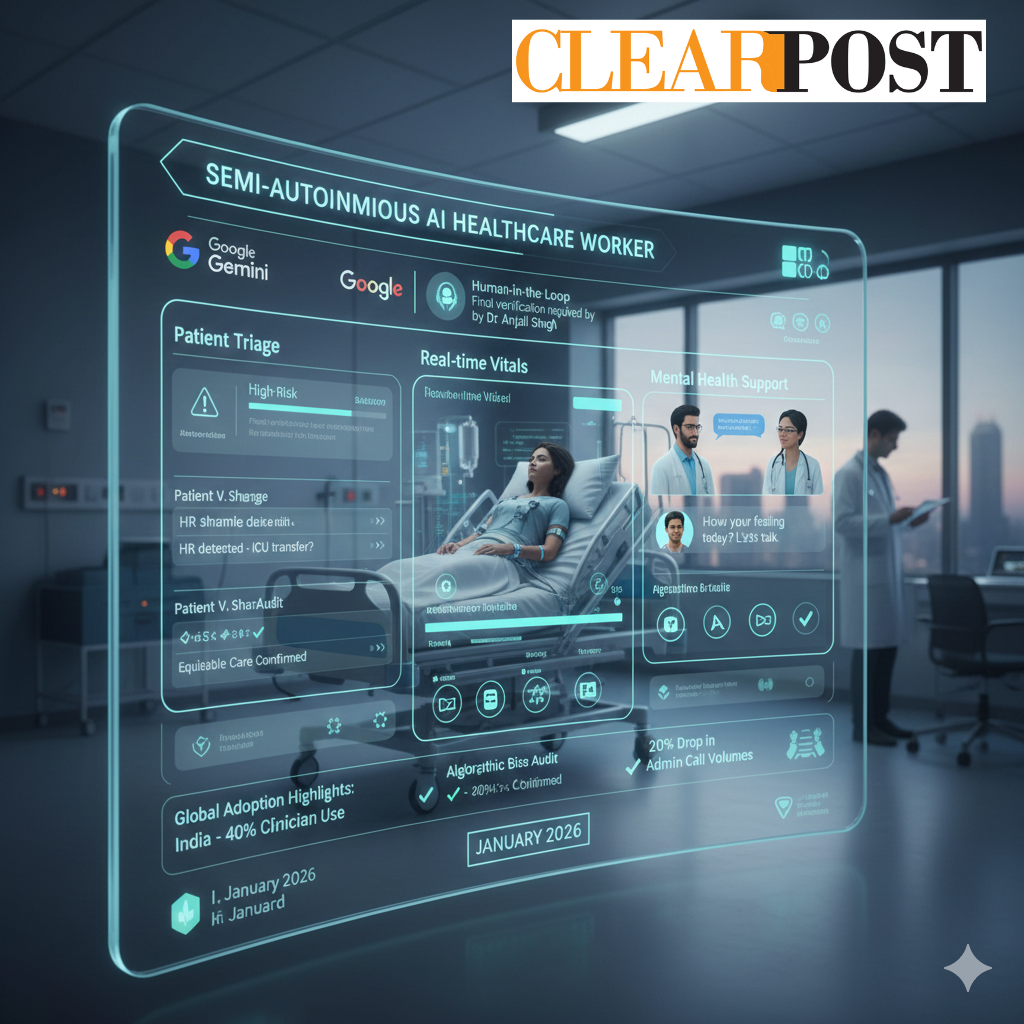
In 2026, the global healthcare sector has reached a pivotal inflection point: the transition from AI as a “tool” to Semi-Autonomous AI Healthcare Workers. Unlike standard chatbots, these “agentic” systems are capable of managing end-to-end clinical and administrative workflows with minimal human intervention, acting as virtual team members rather than just software.
The Shift: From “Assistive” to “Agentic”
In 2025, AI was primarily used for single tasks like transcribing notes. In January 2026, “Agentic AI” has become the standard, where AI agents can:
- Execute Complex Workflows: Instead of just flagging a symptom, an agent can autonomously coordinate the entire patient journey—scheduling the necessary tests, verifying insurance pre-authorization, and flagging anomalies in results for a doctor’s final review.
- Reason and Adapt: Using Retrieval-Augmented Generation (RAG), these workers ground their decisions in real-time medical literature and specific hospital protocols, reducing the risk of “hallucinations” (false information).
Key Roles of Semi-Autonomous Workers
| Role | Key Capabilities | Impact in 2026 |
| Virtual Nurses | Monitor real-time vitals from wearables; triage patients; provide mental health support between sessions. | 25–40% reduction in unplanned ICU admissions via early warning signals. |
| Admin Agents | Handle billing, coding, and appointment rescheduling; guide patients through complex intake forms via voice. | 20% drop in call volumes for major hospitals like Cedars-Sinai. |
| Diagnostic Copilots | Scan thousands of images (X-rays/MRIs) in seconds; highlight high-risk cases for immediate priority. | Achieved near 90% accuracy in real-world clinical environments. |
The “Semi-Autonomous” Guardrail
The term “semi-autonomous” is critical. While these agents can perform 90% of a process (like drafting a discharge summary or suggesting a treatment plan), they operate under a “Human-in-the-Loop” framework.
- Final Verification: A human clinician must verify and sign off on any clinical decision.
- Ethical Oversight: Governance boards in 2026 now mandate regular audits for algorithmic bias to ensure care is equitable across different demographics.
Global Adoption Highlights
- India: Moves from digital adoption to true interoperability. Over 40% of clinicians now use agentic AI, a massive jump from 12% in 2024.
- APAC Region: AI is being integrated into “Next-Gen Smart Wards,” where sensors and AI agents act as the “digital operating system” of the hospital.
- Efficiency Gains: Early deployments show that conversational AI assistants have improved healthcare employee productivity by roughly 14%.
Challenges & The “AI Tax”
Despite the benefits, Nothing CEO Carl Pei and other tech leaders have warned that the “AI Tax” is real. The massive demand for high-end memory chips to power these healthcare agents has contributed to a spike in hardware costs, making the digital transformation more expensive for smaller clinics.
“2026 marks the year AI stops being a novelty and starts being a necessity for the survival of overworked health systems.”
Would you like me to generate an image of a “Semi-Autonomous Virtual Nurse” dashboard monitoring a smart ward, or should I find the latest data on AI implementation in your specific region?