


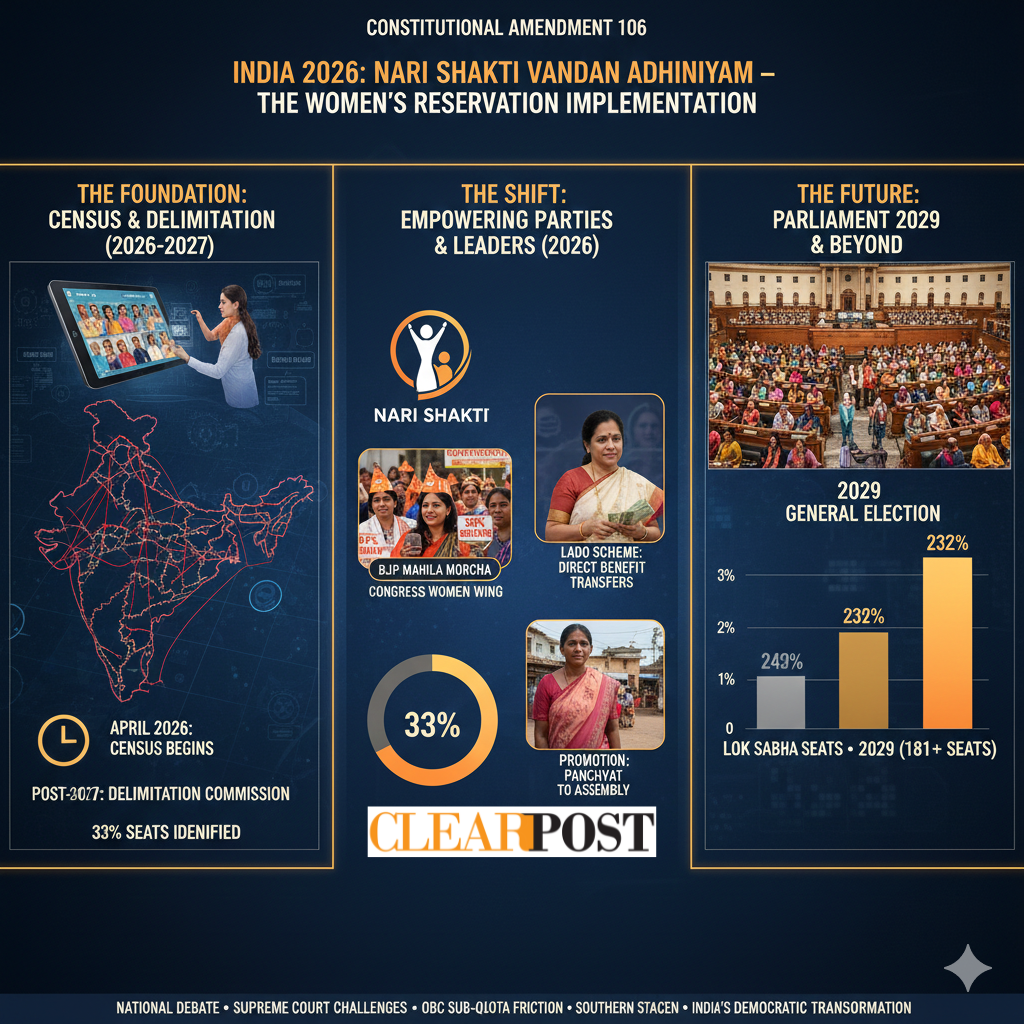
As of January 2026, the Nari Shakti Vandan Adhiniyam (106th Constitutional Amendment) has entered its most critical phase. While the law was passed in 2023, its practical implementation is legally tied to the 2026 Delimitation Exercise, which has now officially begun.
The Implementation Roadmap (2026–2029)
The transition from a “paper law” to “legislative reality” follows a strict constitutional sequence that is currently unfolding:
- Census 2027 (Starting April 2026): House-listing operations for the first digital census are scheduled to begin this April.1 This data will provide the “scientific basis” for redrawing constituencies.
- Delimitation Commission (Post-Census): Once the population figures are released, a high-powered commission will identify which specific 33% of seats will be reserved for women.
- Rotational Policy: The act mandates that reserved seats be rotated after every delimitation exercise to ensure that reservation doesn’t become stagnant in specific regions.2
How Parties are Adapting in 2026
Recognizing that the 2029 General Election will be the first under this quota, political parties are overhauling their internal machinery today:
- “Nari Shakti” Wings Empowerment: Parties like the BJP and Congress have begun mandatory 33% reservation within their own organizational committees (National Executive, State Working Groups) to create a pipeline of battle-ready female candidates.
- The “Lado” and “Behen” Schemes: In the ongoing 2026 assembly polls (Tamil Nadu, West Bengal, Kerala), parties are using massive direct-benefit transfers for women as a “pre-selection” strategy to identify influential local female leaders.
- Grooming Local Leaders: With 50% reservation already existing in Panchayats in many states, parties are “promoting” successful Sarpanchs and Municipal Councilors to state-level roles to meet the upcoming 33% legislative requirement.
Current Challenges & Legal Friction
- The Southern Concern: Southern states argue that if delimitation is based strictly on the 2027 Census, they will lose seats while the North gains.3 They are demanding that the 33% women’s quota be implemented immediately without waiting for the redrawing of boundaries.
- Supreme Court Scrutiny: As of late 2025/early 2026, the Supreme Court has issued notices to the Centre on petitions challenging the delay.4 The court is investigating if the “linkage” between the census and the bill is a rational necessity or an intentional delay.
- The OBC Sub-Quota Debate: Opposition parties continue to push for a “quota within a quota” for women from Other Backward Classes (OBCs), which remains a major point of political friction in the 2026 assembly campaigns.5
Key Data Point: The Representation Gap
| House | Current Women Representation (2026) | Target under Nari Shakti Vandan Adhiniyam |
| Lok Sabha | ~14% | 33% (181+ seats) |
| Rajya Sabha | ~13% | Not covered by current Act |
| State Assemblies | 8% – 12% (avg) | 33% |