


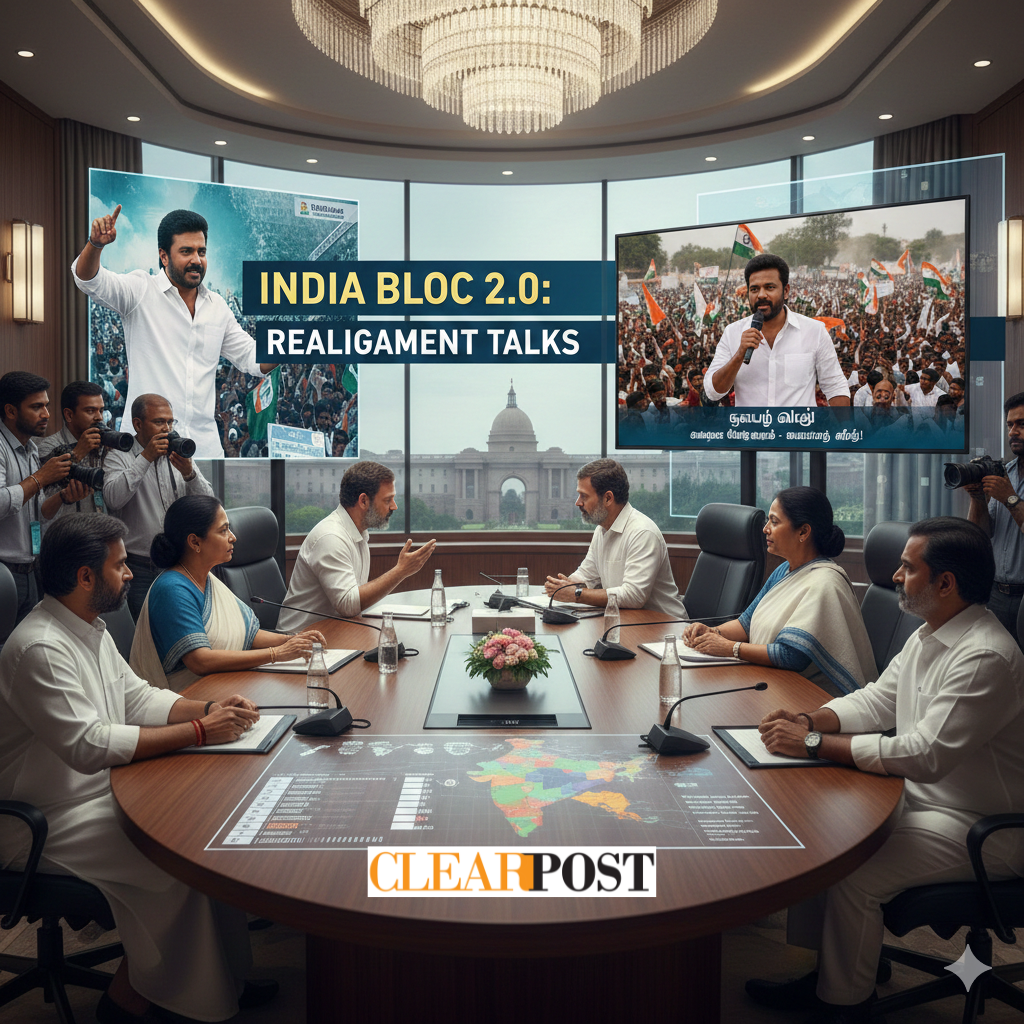
The political landscape of 2026 is defined by a massive restructuring of the INDIA Bloc, as it pivots from a national coalition to a series of strategic, state-specific battlefronts. With the 2024 General Elections in the rearview, the alliance is facing its most significant “stress test” yet as key states like West Bengal, Assam, and Tamil Nadu head to the polls.1
The realignment, often referred to as INDIA 2.0, is characterized by a “flexible federalism” where national cooperation is being balanced against regional dominance and the emergence of new, disruptive political forces.
West Bengal: The “Friend-Enemy” Paradox
In West Bengal, the relationship between the Trinamool Congress (TMC) and the Congress-Left combine remains the most complex puzzle of the 2026 election.
- TMC’s Stance: Chief Minister Mamata Banerjee has signaled a “strategic solo” path, emphasizing that while she remains a pillar of the national opposition against the BJP, the local ground realities in Bengal require the TMC to fight on its own strength to avoid confusing its voter base.2
- Negotiation Hurdles: Despite high-level talks between Rahul Gandhi and Mamata Banerjee, seat-sharing remains stalled over roughly 40-50 urban constituencies. The Congress, buoyed by its recent national performance, is demanding a larger share than the TMC is willing to concede.
- The “Third Front” Factor: The Left Front, led by the CPI(M), continues to maintain its distance from the TMC, often accusing it of being “the BJP’s B-team,” further complicating the INDIA bloc’s unity in the state.
Assam: A United Front Against the Saffron Surge
Unlike the friction in Bengal, the opposition in Assam is moving toward a more cohesive United Opposition Forum.
- Gaurav Gogoi’s Leadership: Emerging as the face of the Congress challenge to CM Himanta Biswa Sarma, Gaurav Gogoi has been instrumental in stitching together a coalition that includes regional players like the Raijor Dal and Assam Jatiya Parishad.3
- Tactical Seat-Sharing: The focus here is on “one-on-one” contests against the BJP to prevent the split of the anti-incumbency vote. The primary challenge remains the AIUDF; while some within the Congress favor an alliance to consolidate the minority vote, others fear it could alienate the indigenous Assamese voters, a demographic the BJP has successfully courted.
Tamil Nadu: The Rise of the “Third Force”
The most dramatic shift in 2026 is occurring in Tamil Nadu, where the long-standing DMK-AIADMK duopoly is facing a challenge from a cinematic icon.4
- Vijay’s TVK Disrupts the Narrative: Actor Vijay’s Tamilaga Vettri Kazhagam (TVK) has officially entered the fray, declaring the DMK as its primary “political enemy” and the BJP as its “ideological enemy.”5 Vijay’s entry has unsettled the INDIA bloc’s internal dynamics in the south.
- Congress Bargaining Power: Within the DMK-led alliance, the Congress is using the “Vijay factor” as leverage. Sensing that the DMK may need more support to ward off a split in the youth vote, the Congress is reportedly pushing for a higher seat count and, for the first time, a formal share in the state power structure (Coalition Government).
- Stalin’s Strategy: Chief Minister M.K. Stalin is banking on a “Dravidian Model” of welfare to retain his 2.5 crore voter target, but the TVK’s ability to draw away young, first-time voters could turn three-way contests into unpredictable outcomes.
The National Impact: A Prelude to 2029
The 2026 realignment is more than just about state assemblies; it is a laboratory for the 2029 General Election.
| State | Primary Conflict | Key Trend |
| West Bengal | TMC vs. BJP vs. Left-Congress | Regional dominance vs. Alliance needs. |
| Assam | NDA vs. United Opposition | Consolidation of the anti-incumbency vote. |
| Tamil Nadu | DMK+ vs. AIADMK+ vs. TVK | Challenge to the traditional Dravidian duopoly. |
The “INDIA 2.0” strategy seems to be moving away from a monolithic national alliance toward a “State-First” model. Success in 2026 will depend on whether these parties can fight each other in the states while maintaining a unified front in New Delhi—a delicate balancing act that will define the future of Indian democracy.