


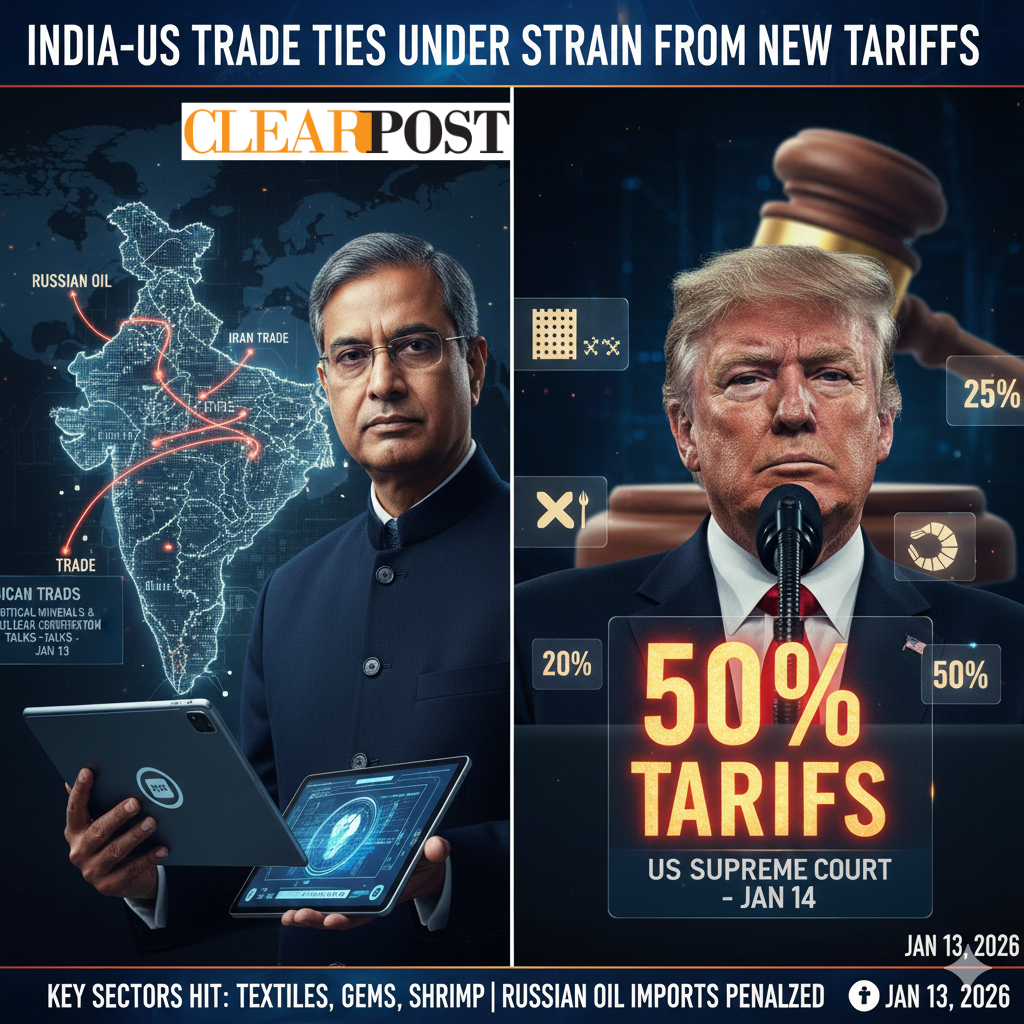
Trade relations between India and the United States have entered a high-tension phase as of January 2026, following a series of aggressive tariff measures by the second Trump administration. The strain is primarily centered on India’s “strategic autonomy”—specifically its trade with Russia and Iran—and its domestic protectionist policies.
1. The 50% “Dead Economy” Tariffs
In a move that caught New Delhi by surprise, President Donald Trump escalated tariffs on Indian goods to 50% in late 2025.
-
Targeted Sectors: The tariffs heavily impact labor-intensive industries, including textiles, gems and jewelry, and the shrimp industry. Approximately $50 billion of Indian exports are now under these steep levies.
-
The Catalyst: Trump recently labeled India a “dead economy” during an escalation in trade rhetoric, signaling a major shift from the “strategic partnership” narrative of previous years.
2. The “Russian Oil” Penalties & 500% Threat
The most significant point of friction remains India’s continued purchase of Russian crude oil.
-
Current 25% Levy: The US has already imposed a 25% punitive tariff specifically linked to New Delhi’s Russian energy imports.
-
The “500% Hammer”: US Senators Lindsey Graham and Richard Blumenthal have introduced the Sanctioning Russia Act of 2026, which would empower the US to levy tariffs as high as 500% on any country trading in Russian-origin oil, gas, or uranium.
-
India’s Response: The Ministry of External Affairs (MEA) maintains that India is guided by “energy security needs for 1.4 billion people” and continues to monitor the “evolving dynamics” of the US bill.
3. New 25% Tariff on Iran Trade
On Tuesday, January 13, 2026, President Trump announced a new 25% tariff on any country doing business with Iran.
-
Impact on India: While government sources suggest the direct economic impact is “minimal” (trade with Iran is less than $2 billion), the move puts massive strain on India’s Chabahar Port project and its role as the 2026 BRICS Chair, given Iran is a full member of the bloc.
4. Diplomatic Firefighting: Jaishankar-Rubio Talks
External Affairs Minister S. Jaishankar held a phone call with US Secretary of State Marco Rubio on January 13 to de-escalate tensions.
-
The Agenda: The talks focused on trade, critical minerals, and nuclear cooperation.
-
Market Optimism: Investors are closely watching the US Supreme Court, which is expected to rule today (January 14, 2026) on whether Trump’s use of emergency powers (IEEPA) to bypass Congress for these tariffs is constitutional.
5. Economic Outlook: Resilience Amid Shocks
Despite the trade war, global bodies remain optimistic about India’s domestic strength:
-
World Bank: Raised India’s FY26 growth forecast to 7.2%, citing robust domestic consumption and tax reforms. However, it warned that growth could slow to 6.5% in FY27 if the 50% US tariffs remain in place.
-
UN Report: Predicts India will remain the fastest-growing major economy, as strong internal demand “largely offsets” the US tariff blow.