


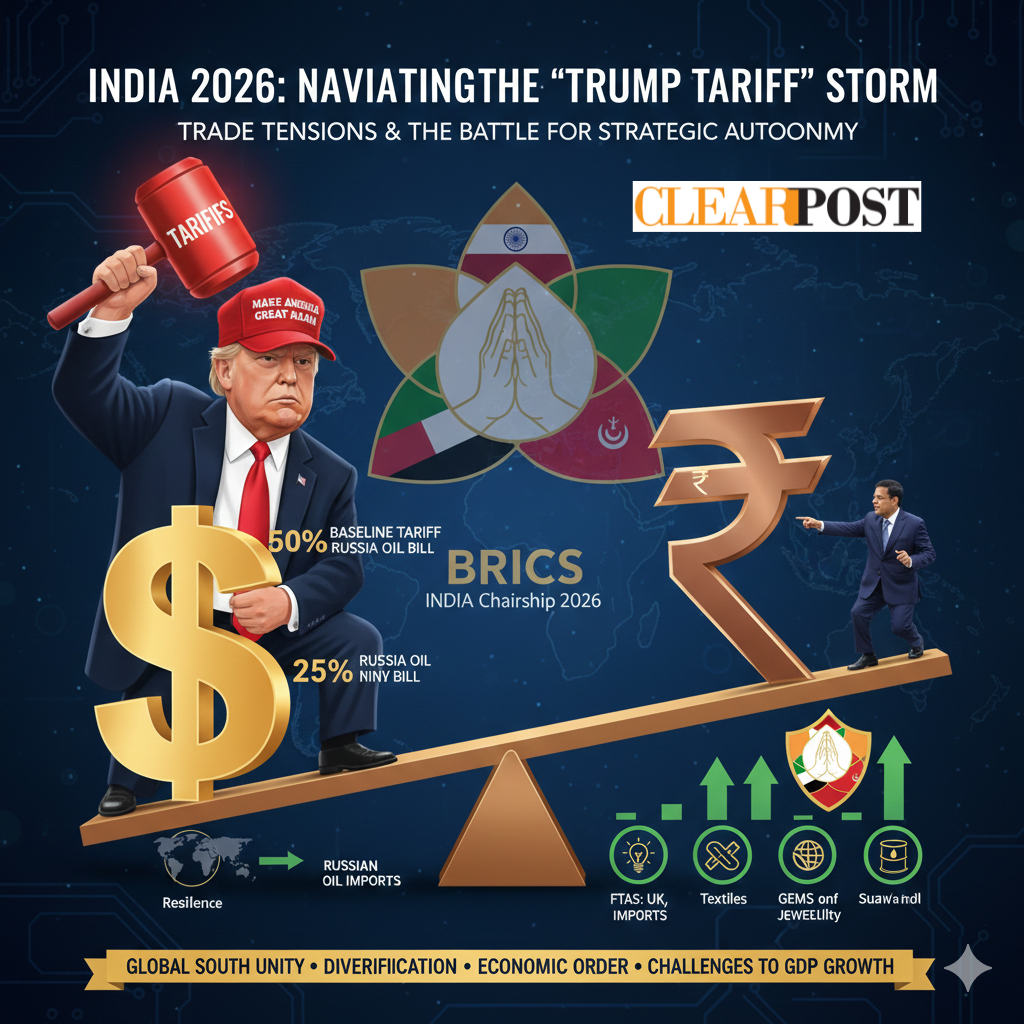
In early 2026, India’s economic diplomacy is being tested by a “Perfect Storm” of trade protectionism. The return of the Trump administration has seen the implementation of aggressive tariffs that have placed India’s export-led growth and its principle of “Strategic Autonomy” under unprecedented strain.1
The “Tariff Wall” of 2026
As of January, India is grappling with a cumulative tariff regime that has effectively cooled bilateral trade:2
- The 50% Baseline: Indian exports to the U.S. currently face a 50% punitive tariff on most goods. This is a combination of a 10% baseline duty, a 25% “reciprocal” tariff for alleged unfair trade practices, and an additional 25% surcharge linked to India’s continued purchase of Russian crude oil.
- The 500% “Russia Bill” Threat: A new U.S. bill, “greenlit” by President Trump in early January 2026, proposes tariffs of at least 500% on any country trading in Russian-origin oil, gas, or uranium.3
- The Iran Ultimatum: On January 13, 2026, the U.S. announced a 25% tariff on any country maintaining trade ties with Iran.4 While India’s direct trade with Iran is small (~0.15% of total trade), this complicates India’s strategic investments in the Chabahar Port and the INSTC corridor.5
Sectoral Impact: Winners and Losers
The trade war has created a stark divide in the Indian economy:
| Highly Impacted (Losers) | Insulated/Exempt (Winners) |
| Textiles & Apparel: Exporters report up to 50% decline in turnover; losing market share to Vietnam. | Pharmaceuticals: Remains largely exempt to safeguard U.S. supply chains for generic drugs. |
| Gems & Jewellery: Massively hit by the 50% tariff, leading to labor-intensive job losses. | Semiconductors: Exempt as part of the strategic tech partnership (iCET). |
| Auto Components: Margins squeezed by high input costs and falling overseas demand. | IT Services: Relatively insulated, though tighter H-1B visa rules remain a secondary threat. |
India’s Strategic Response: “The Shield of Autonomy”
External Affairs Minister S. Jaishankar and Commerce Minister Piyush Goyal are pursuing a multi-track strategy to navigate this crisis:
- De-risking through Diversification: India is accelerating Free Trade Agreements (FTAs) with the UK, EU, and Oman to reduce its 11% trade dependence on the U.S. market.
- Strategic Patience: Despite the 50% tariffs, India has notably refrained from retaliatory tariffs on U.S. goods (like almonds or apples), keeping the door open for a “Framework Agreement” later in 2026.
- Energy Sovereignty: The Ministry of External Affairs (MEA) has officially stated that India’s energy sourcing is guided by “affordability for 1.4 billion people,” effectively refusing to halt Russian oil imports under duress.6
- The “Namaste” Diplomacy: Using its 2026 BRICS Chairship, India is positioning itself as the voice of the Global South, highlighting that “geopolitics and commerce can no longer be treated separately.”7
The 2026 Economic Outlook
The World Bank has adjusted India’s GDP growth forecast for 2026-27 to 6.5%, assuming the 50% U.S. tariffs remain in place.8 While India remains the fastest-growing major economy, the “Trump Factor” has forced New Delhi to move from an era of “Strategic Partnership” to an era of “Strategic Repair.”